Race nerds – if you want to drop in on the Boston Marathon, it’s live on cable and the internet. Monday morning, April 15th! Way more exciting than golf on tv.
http://finance.yahoo.com/news/universal-sports-announces-multi-platform-190129817.html
Race nerds – if you want to drop in on the Boston Marathon, it’s live on cable and the internet. Monday morning, April 15th! Way more exciting than golf on tv.
http://finance.yahoo.com/news/universal-sports-announces-multi-platform-190129817.html
I recently finished Unbroken by Laura Hillenbrand. The book tells the true story of Louis Zamperini, an Olympian and WWII POW.
When I’m in training for a goal race I think it’s really motivational to mix an occasional book or movie about running into my leisure time. My wife had borrowed Unbroken for me from a friend a few months ago and it sat on a dresser collecting dust. I had a vague idea that it was a riveting true story about a POW. I didn’t realize it was about Louis Zamperini or running. I had heard of Zamperini before but didn’t realize this book was about him. Then I happened to notice an athlete profile in RW last month where it was listed as a favorite book of the athlete.
Once I realized that I had immediate access to the book, I couldn’t read it fast enough. The book is basically in three acts – pre-war childhood and racing; the war; and post-war. Zamperini was a middle distance runner with huge potential. He qualified for the 1936 Berlin Olympics in the 5000 meters at age 19. He didn’t medal, but ran an incredible bell lap. Many think he would have been the first to break the 4:00 mile had his rise not been interrupted by the war. This is vividly illustrated by a blistering timed run he made while at one of his island stations in the Pacific, witnessed only by a friend pacing him in a Jeep.
The war not only interrupted his racing career, it ended it. After his bomber was shot down in the Pacific he survived in a raft for a month and half, only to be captured and imprisoned by the Japanese. His mistreatment at the hands of his captors was a brutal combination of beatings, subhuman living conditions, and inadequate food.
After being liberated by American forces at the end of the war, Zamperini briefly attempted to train to race again, but an ankle injury suffered in captivity soon reared its ugly head and put an end to any ideas of returning to competition. He suffered from PTSD and nearly drank himself to death. However, his wife stood by him, eventually bringing him to a Billy Graham revival, which catalyzed a change in his behavior and outlook on life. He has since traveled extensively as a motivational speaker and has been a torch runner at several Olympics.
Despite horrible adversity, physical pain, and the emotional pain of unrealized potential, Zamperini continues to lead a life that inspires his sport and anyone that comes into contact with him.
The book is the second work by the author of Seabiscuit. Zamperini’s true story is meticulously researched and attributed. The bulk of it is set in wartime, but Zamperini’s status as a world-class athlete followed him into captivity and throughout his life.
I was left with with a deep sense of admiration for a man with the drive to succeed at the highest level, the endurance to survive horrific conditions, and the will to overcome assaults to his psyche and reclaim his life. He is truly “Unbroken.”
I have been meaning to post about this shoe for a while now, certainly before getting to 127.36 miles in them. It just might be the best zero drop trainer I have owned, becoming the shoe I am mostly likely to put on for a long run. On the other hand, they feel just a little too klutzy to me to race in.
I came to this shoe early this year after taking my annual 1 month break from running (subbing in elliptical) and looking to put a little more cush between my foot and the pavement for those winter runs outside. I had been running in some New Balance MR00s but my feet were still a bit achy from two fall marathons and the training leading up to them.
According to Mizuno, the shoe is named for Eudibamus Cursoris, one of the oldest known bipedal creatures. Of course Latin scholars will immediately know the meaning of this name: “original runner on two limbs.” Having viewed some artists’ conceptions, the little guy looks pretty speedy to me.
The shoe has a deceptively mainstream/traditional look to it, i.e., I bet most people wouldn’t even realize it’s a zero drop shoe. While I don’t buy shoes based on how they look (my first generation Instincts, for example), some have even uttered the phrase “cool shoes!”

I think the shiny material on the upper around the laces (click the pic for a larger image) was intended by Mizuno’s designers to look like dino skin, but I can’t prove that!
Billed as a true zero drop, you are sitting up on 12mm of cushioning. It’s noticeably more cushioned than the aforementioned MR00s, or the Altra Instincts I have been rotating with since the first of the year:
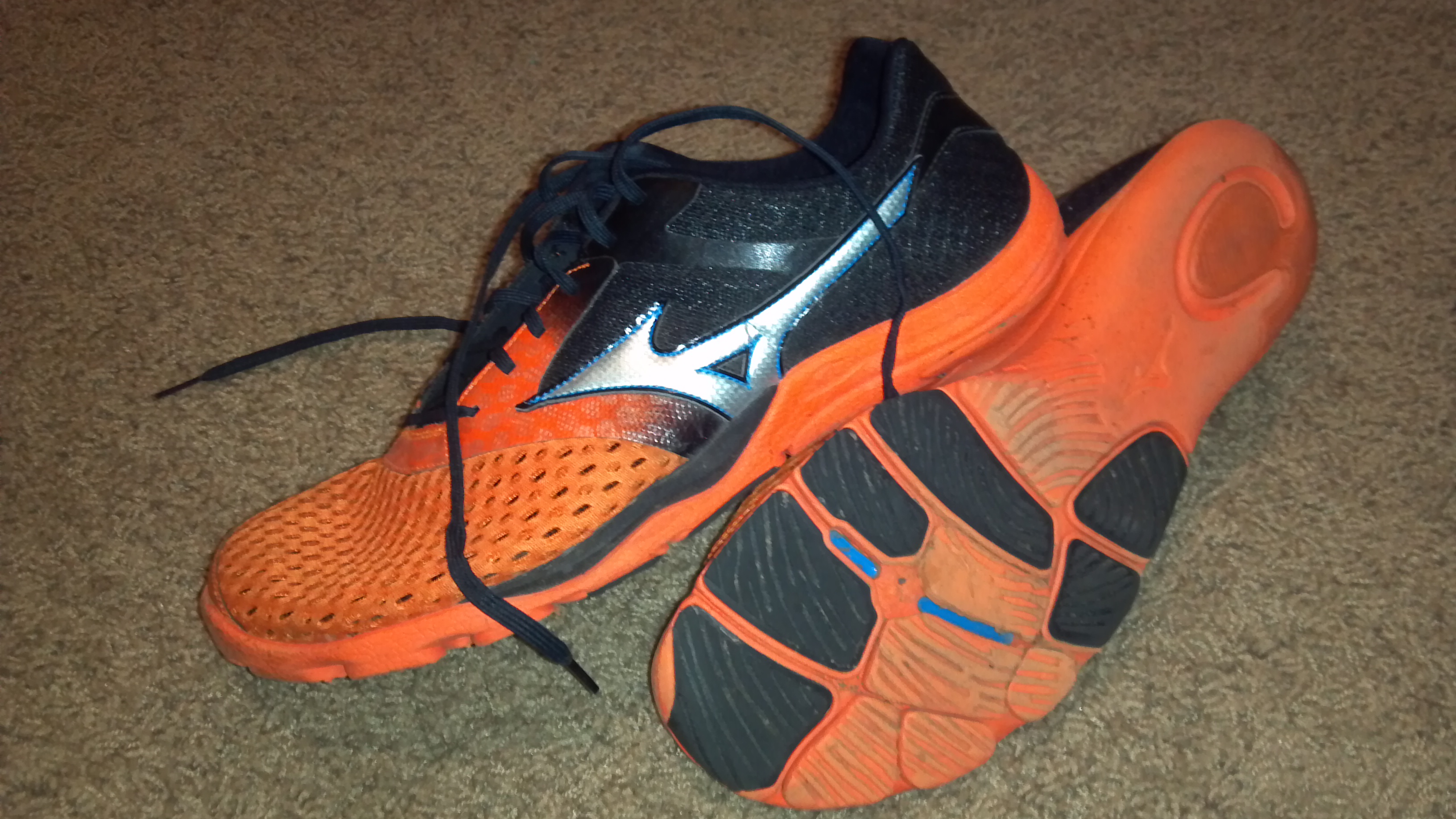
I am no running shoe terminology expert, but as you can see, the sole has a more durable black material in areas presumably identified as striking or takeoff points. A less durable orange material makes up the majority of the sole, including the heel area (where you shouldn’t be striking anyway, right?!) If you ask me, this little section just behind the exposed Wave plate could use the more durable material:

As to that Wave plate, I don’t notice or feel anything most of the time, but at one point in the second half of a recent long run I did have the distinct sensation that I was loading it up and feeling some compression and rebound.
The shoe isn’t exactly tearing itself up at 100+ miles. In fact I’d project it to be fairly durable despite the visible peeling in these pictures. I don’t foresee any problems getting the “traditional” 500 out of it, but then again I’m not pitching…err…donating shoes at 500 miles anymore.

I am someone who admittedly agonizes over shoe fit. Years ago, I used to dogmatically buy shoes in “my size.” Being older and wiser now, I’ll try on at least the half size up from “my size,” or down as the case may be (I recently bought some very oddly sized dress shoes that took me down a full size, creating a great deal of cognitive dissonance). This shoe convinced me to go a half size up. I really like its roomy toe box. I think I have the right size for me. However, I just can’t shake the feeling of a certain amount of clumsiness. I have run in other wide toe box zero drop shoes without this problem, notably the Instinct. For whatever reason, I seem to be magnetically attracted to at least one pavement heave per long run in the Cursoris, much to the amusement of passerby, no doubt. The shoe is light, but doesn’t “feel” fast, I think because there’s so much of it there. In saying that though I feel like I am asking the shoe to be something it is not. There is another shoe in this line, the Levitas, which is supposedly more geared towards speed, with the attendant sacrifices in cushioning. Perhaps I will give it a try at some point.
Update 05/22/13: These now have double the miles of when I wrote this review: 259.39. They’re still holding up well, with no signs of nearing the end of their useful life. I find myself going to this shoe almost exclusively for pavement training runs (my rotation in the last month has been these and barefoot). I still catch pavement heaves in them from time to time, but overall I’m very satisfied.
Update 06/13/14: I recently realized I haven’t run in this shoe for a few months (February, topping out at just over 550 miles, definitely with a few hundred left, barring some unforeseen catastrophic failure). When I wanted a cushioned trainer, the WEC was my go-to. However, ever since I got a pair of Skora FITs, at the end of February, I haven’t come back to the WEC. I liked the WEC, but it’s a testament to the FIT that we’re going steady now. My review of the FIT is here:
I’m busy. Sure, we’re all busy. I’m no busier than you (more on that in a minute). Some weeks you have to be a little creative to cram in a run or a workout without sacrificing those precious minutes with your family. For many of us, that means just getting up a little earlier than we’d like to. For others, it means staying up later than we should. Personally, I have no idea why hitting the elliptical at the gym at 5 am seems to be more socially acceptable than at 11 pm, but that’s just me.
Running when the kids are in bed has always been my preference. I have both headed out the door after dark and arisen for morning runs before first light many a time. However, there are times when lack of sleep, meal schedules, and other activities just render that impossible. Such was my theme for the week.
Tuesday was a scheduled 8 mile Semi-long workout for me. A 2 mile warmup, followed by another 6 miles at a faster pace. The only “available” time slot? My son’s soccer practice, indoors at an elementary school. (Too bad – running barefoot around the plush soccer fields at Lone Elm Park is one of my faves – c’mon spring!). I could have driven over to the gym and hit the ‘mill, but that would have cost me 5+ minutes at either end. Instead, I was glad to find that the school had a super-long main hallway and a friendly custodial staff. It was boring, but I got in a solid hour of going back and forth. I didn’t count, I didn’t measure, and I didn’t bring my Garmin. I just went by feel and tried to keep my pace up with rhythmic breathing (something I have written about before – I didn’t know it had a name and devotees until this months Runners World article!). Pretty sure I got the 8 miles in. I also popped into the gym periodically to check in. It worked great – much better than a drop off and pick up.
Thursday had a 7 mile tempo run on the slate. My son caught wind that I was was headed out as soon as I got everyone in bed and pounced: “Daddy, can I run with you?” Cue Harry Chapin. There have been times when I have said no. Usually I have a “good” reason – it’s too late, I’m going too far, etc. Some reasons are about the kids, some are about me – admit it. This time, I’m glad to say I didn’t hesitate. It was about 8:30 pm. He had school tomorrow, but it was the last day before spring break. It was cooling off, but the temps had been in the 70s and there was that glorious post-dusk vacillation of warm air currents and cool valleys. Why not? Yes, I said. Let’s go for a run. We did a 3 mile out and back. Our pace was slower than I would have run for my warmup if I had been by myself, but I boosted my effort by carrying the conversation. After dropping him off, I headed back out for the fast-paced part of the tempo run – 3 miles with a mile cool down. I did that as a 4 mile out and back.
Finding the time and effort to say yes when your kids get excited about running is worth whatever you give up in terms of minor personal goals for a workout. Finding ways to spend more time with family and still squeeze in your run is always worth it – whether that’s running at weird times or in weird places!
Whenever I get a little too full of my own “busy-ness” I am reminded of the way the Count of Monte Cristo cuts down the self-important Villefort (like me, an attorney, I might add): “Why, in truth, sir, … man is but an ugly caterpillar for him who studies him through a solar microscope; but you said, I think, that I had nothing else to do. Now, really, let me ask, sir, have you? -do you believe you have anything to do? or to speak in plain terms, do you really think that what you do deserves being called anything?”
The Count’s point is not that our lives are devoid of meaning. I choose to think that we must strive to capture meaning through the estimation of others – not our own!
I headed out the door Saturday for a long run in Columbia, MO, where we were visiting my in-laws. I have a few routes I enjoy there, but with the snow they were out, so I planned on sticking to places I knew would be plowed.
There is nothing simpler than planning an out-and-back. Here’s a quick primer: (1) decide on total distance; (2) start running in one direction until 1/2 of total distance is achieved; (3) turn around and run in the opposite direction. Seemingly condescending sarcasm aside, it did remind me how much more fun a loop can be since you’re not retracing your steps. With a little planning, you can get pretty close to your target distance, and you never have to look at the same scenery twice. On the other hand, the simple out-and-back has its virtues as well. Even on an unfamiliar route, it’s familiar on the way back, so you can push a hill knowing what lies beyond, or slow the pace as needed.
On this run, I had at least one happy coincidence. First, my planned distance landed me literally at the doorstep of Mizzou Arena as a turnaround point. There aren’t any steps, so the Rocky music wasn’t going through my head, but it was inspiring to be threading between Hearnes and Faurot Field as well.
This is a two-for-one post, so turning my stream of consciousness to the other topic: long run hydration. I hate those belts. I tried one once. Once. I just couldn’t deal with all the flopping around and riding up, etc. Of course I wouldn’t have even tried one if I didn’t hate having stuff in my hands while running. Lately, I’ve been mapping out long run courses that go by a convenience store close to my turnaround point. I’ll make sure I’m good and hydrated, head out the door with a couple of bucks in my shell, and zip in for a quick apple juice at the halfway point. An alternative would be a to join a running group that sets up aid stations for Saturday long runs. I know there are a few. I have been tempted to bandit their offerings at times on the Mill Creek trail, but so far my conscience has won out. Another way is to drop something at your turnaround point in advance of your run. I’ve done that too. Anything to avoid weight in my hands. It just gives me the feeling that I am unnaturally altering my form when I’m lugging a bottle or two around.
Apologies to Robert Heinlein. The training schedule yesterday said Speed Workout: 7×800. Since I slackered the first speed workout on the schedule two weeks ago with the dual excuses of cold and darkness, I decided to find a more worthy substitute than the elliptical. Again confronted with cold and darkness, my usual outdoor “track” locations weren’t going to cut it. Even if I could see my splits in the dark, temps in the low 20s and 10+mph wind aren’t that conducive to speed. So I decided to hit the ‘mill. First, I set the incline to 1% and got a fan going. After a mile of warming up, slowly cranking up the speed towards 8:00 miles, I was ready. Target pace was a 5K 6:07. This being my first speed workout in a while, I backed it off of 6:07 a touch for the first lap. One brain cramp and 400m later, I was “done” with the first interval. I decided to do 3/10 mile cool downs in between, and then pulled off 5 800m intervals starting at 6:07 and stepping down one increment slower (6s or 7s or so) for each successive lap. My last interval was another shortened 400m due to (1) a developing hot spot on my left sole – thanks, ‘mill! and (2) had to pick up Cole from bb practice. Observations: it is mentally easier to not slack off once you have dialed in a pace for an interval on the ‘mill. When you’re out there on the track, it’s harder to keep a steady fast pace by yourself, even with a Garmin. On the ‘mill, you’d have to really admit defeat by shamefully pressing the “decrease pace” button. It’s like there’s someone cracking a whip behind you as you mentally shout “come on 5.7!” The downside of the ‘mill of course is that it’s really not the same as running on solid ground. Not a bad substitute for every once in a while, but I wouldn’t want it to be the usual. Also, too much friction as evidenced by the almost-blister I was working on. Total mileage: 6.
When I started running barefoot and in minimalist shoes a few years ago, other than the forefoot striking, the biggest thing I noticed about my form was that I was taking shorter steps and more of them. This is virtually impossible not to do when running barefoot – much like heel striking is just about impossible when barefoot.
As it turns out, many sources (Chi Running, Daniels’ Running Formula, Born to Run, 16 Weeks to a Faster Marathon to name a few) recommend that you run at about 180 steps per minute. You might also see this referred to as strides per minute or beats per minute (especially if you’re looking for iPod songs). The reasoning behind this is that fewer than 180 spm leads to overstriding and increased risk of injury. I’m not sure if there’s a downside to going much over 180 spm, other than decreased efficiency. At any rate (well, not just any rate) 180 is supposedly the Golden Mean.
Personally I find that it’s easier for me to keep my spm up when I’m running barefoot. When I’m minimally shod though it is slightly harder to keep from plodding along. One of the tools I use to give myself a checkup on this periodically is a clip metronome like this:

I found this for around $15. I suppose you could clip it on something but I prefer to just hold it. That way you can turn it off and conceal it when others approach to cut down on that weirdo factor (as if forefoot striking or barefooting wasn’t giving you away already). You can of course adjust the volume and the beats per minute. I find that 185 is more comfortable for me sometimes, but mainly the purpose is to keep from falling below 180. Another way you can keep your pace up is by downloading songs to your iPod that have 180 bpm or close to it. Personally I can’t stand all the cords and sweat management issues that come with an iPod so I haven’t tried that. For true devotees, there’s also software that can digitally speed up your favorite tunes to the magical 180.
Although it will add another paragraph to this post, there are varying schools of thought about breathing and stride rate. Some would say one of the great advantages of walking upright is our ability to detach breathing from our stride, i.e., striking the ground doesn’t force us to breathe as it does with quadrupeds. Others say that you should breathe in a 3:1 ratio (3 steps, breathe in, 3 steps, breathe out, repeat). This works pretty good for most distance running, although you can definitely overthink it. I just think about it every once in a while on a run – am I running triplets? You’ll notice that you won’t be able to keep 3:1 up when you’re working harder – either on a hill or at a faster pace. I’m usually going 2:1 there, and I wouldn’t be surprised if there is some correlation between switching to 2:1 and the lactate threshold pace.
Whew! Running isn’t that hard. If you just remember left, then right, you’ll be fine, but running at 180 helps me to run well.
The Good: First barefoot run of the year yesterday; low 50s, 5 miles with my Red-Hot Smokin’ Wife (hereinafter the “RHSW”); mud squishing between my toes.
The Bad: Umm, it’s not spring. Crunchy scrub instead of grass. Cedar thorns in my baby-smooth feet that haven’t been exposed since November.
The Ugly: Stubbing my big toe while simultaneously trying to avoid 1) a swath of bird poop under an overpass; 2) plowing into the RHSW after attempt #1. Blood. Minor nail damage. Perhaps a ligament strain. I’ll live.
My Sunday am run this week was solidly in the middle of a cold. I’m not a doctor, and I don’t play one on tv either. However, over time I’ve developed a few rules of thumb for deciding whether or not to head out the door with a cold. Fortunately, this only seems to happen once or twice a year. But it is that time of year!
I considered making a flowchart, but that would imply some superior knowledge or wit, or both. Here are my basic rules for exercising while sick. They basically boil down to “do I feel like it?” I think being honest with yourself and your body is always the best way of making these decisions.
1) Fever? Feverish? (low grade or just suspected). Stay in bed.
2) Productive cough? Bed.
3) Nausea/vomiting? Do you have to ask? I don’t know too many people who would ignore that one.
Those are the no-gos. I do consider a run with any of these:
1) Runny/snuffy nose. This can get pretty gross, but I feel better during and afterwards. No communal activities here though – you’re going to see those people at the gym again whether or not you know their names. You don’t want to be that guy/girl. Eww.
2) Headache. If it’s part of an overall thing – e.g. sinus-related, I find physical activity helps me here, so despite feeling lousy I’ll give it a try.
3) Fatigue. Again – listen to your body. If it’s because you’re not getting enough rest – do yourself a favor and get some. However, at the tail end of a cold or something minor, it’s easy to keep holding on to the “I’m sick” or “I’ve been sick” or “I was sick last week” as an excuse. If I’m pretty sure I’m over it, I try to get back out there.
Training while you’re sick isn’t much fun. If you’re not too sick I think it gives you a temporary boost. I felt good during my Sunday am run. That wore off later in the day, but I wouldn’t say it was a setback. The trick is not being so much of a slave to a training schedule that you wind up having to shut down for a while because you didn’t let your body fight off whatever you’re dealing with; and also not using it as so much of an excuse that you find you’ve gone two weeks without doing much of anything!

I finished this book over the weekend. Very interesting. I must say I was pleasantly surprised at the degree to which it incorporated exercise physiology into the subject – in fact I found myself saying: “when do we eat?” That’s a bit of an exaggeration. There’s a summary of the diet at the beginning, followed by several chapters on what to eat before, during, and after exercise. All this is broken into 5 stages. The next few sections back up the nutrition, fitness, and performance claims of the authors with their review of applicable research. The final section contains lists of EAT and DON’T EAT (my terms) followed by dozens of recipes.
I wasn’t previously familiar with the Paleo Diet other than thinking “that’s the one where you eat nothing but meat, right?” This is a diet in the true sense of the word, not the vernacular we’ve all grown up with. It’s a way of eating for life, not a 6 week program to drop x number of pounds.
I’ve decided to experiment with this. I had recently decided to put myself on a reduced gluten diet (I hesitate to say gluten free) and this diet is a natural extension of that – although there are many more off-limits foods than a GF diet. I would sum it up with this quote: “the Paleo Diet [is] …unrestricted consumption of fresh meats, poultry, seafood, fruits, and vegetables. Foods that are not part [of it] include cereal grains, dairy products, high-glycemic frutis and vegetables, legumes, alcohol, salty foods, processed meats, refined sugars, and nearly all processed foods.” There are exceptions. For instance, the authors recognize that simple carbs in the form of sugars can be a necessary fuel in certain stages before, during, and after endurance exercise.
One of the more intriguing parts of the book is how the diet has the potential to teach your body to burn more fat and dip into your glycogen reserves less until it’s absolutely necessary. I’m interested in anything that can avoid the wall – more of a marathon problem than a half marathon problem. The book does have a specific section on what to take in during various time periods of exercise – including what for most of us mortals would include the half marathon distance.
I’m not trying this to lose weight. My goals are increased performance and health benefits. The book makes a good case for both of these. I’ll let you know how it goes. I will say that it’s been hardest to cut out/down dairy and refined sugars. Especially when they are combined into ice cream. However I am encouraged by mention of the 85% rule – follow the diet 85% of the time. That might be doable.
To balance this perspective I’m also planning on picking up Scott Jurek’s “Eat and Run” 100% plant based diet at some point. I confess some natural skepticism of the vegan diet’s ability to give the body everything it needs, although Scott has certainly earned his credibility to speak on that issue (Badwater, Western States to name a few).
 cretanrunning