Skrewed Skoras: A winter tutorial

I hadn’t run a trail race in icy/snowy conditions before this Saturday’s “Alternate Chili 10 Mile Run” (actually, 10.35 miles!). With a wintry mix in the forecast, I made some preparations to screw my shoes, as recommended by the Trail Nerds, the race sponsor. Hexagonal, slotted sheet metal screws are a great way to add traction if you are going to encounter snow and ice on a trail. I haven’t tried this on paved roads/trails. I’ve always found I get sufficient traction from my Skoras on the road. You’re not making track spikes here – you can’t or wouldn’t want to put the screws in from the top of the shoe. The many faces of the head of the screw are what provides the added bite.

Since the screw lengths recommended by the Trail Nerds aren’t compatible with minimalist shoes, some modification was necessary. So, with apologies and this rather vague attribution to their fine tutorial, here’s the Skora version. Please note: I did this with my Forms. It should also work with the Base, since they share the same R01 outsole. I’m not sure this would work with the R02 outsole on the Phase and Core.

Step 1: Take off your shoes (obscure Swants reference – worth a Google if you don’t get it).

Actually, this isn’t strictly necessary. If you’re rushing to do this right before a race or run, or doing it for a friend who’s already got them on, you’re not going to poke them/yourself in the foot so long as you are using the right screw length. I do think it’s a lot easier if you’ve got the time to do this before.

Step 2: Find some screws, and something to screw them with.

Ok, here’s where it gets technical. Joking. If you own any tools at all, odds are you’re going to be able to handle this.

Selecting/finding the right screw is really the hardest part. You don’t want the end of the screw poking up through your sole into your foot. I did NOT think that 3/8″ length would work, so I used #4 – 1/4″ length screws. The #4 refers to the head size. The 1/4″ is the length of the shaft of the screw.

2013-12-16_07-59-19_748

Only $4.99 for 100! You’re not going to find these at your big-box hardware store. I tried, I failed. 3/8″ is as short as they go. Try a specialty mom & pop store. Something with hardware in the title.

2013-12-16_07-59-35_617

Small but mighty.

2013-12-16_07-58-12_897

2013-12-16_07-58-48_489

These two tools aren’t necessary, but they will make it go faster if you have them. The bottom pic is a socket for the hex head of the screw. The size is 3/8″ (matches #4, don’t ask). If you can find a magnetic one, so much the better. Once you pick up the screw you’ve dropped for the tenth time, you’ll thank me. But like I said, if you don’t have the power tools, the hex head screws are slotted, so a regular screwdriver will work too.

Step 3: Pick a pattern and start screwing the screws in.

I’m a first-timer, so you aren’t getting the benefit of a lot of experience here. My advice would be: don’t go overboard; put them in contact/takeoff areas (look for wear); put a few at the back (I’m not a heel striker, but if you start sliding, you’re going to use parts of the shoe you wouldn’t ordinarily use); do it symmetrically; and start the screw at a high point on the sole (i.e., don’t start the screw into one of the holes or slots in the pattern – you want as much rubber as possible gripping the screw). I just ran them in to flush. Don’t overscrew them or they might poke through. Here’s the pattern I came up with:

2013-12-14_07-57-24_295

Pretty symmetrical. I think the only one you can’t see is one I put up in the big toe area on each shoe.

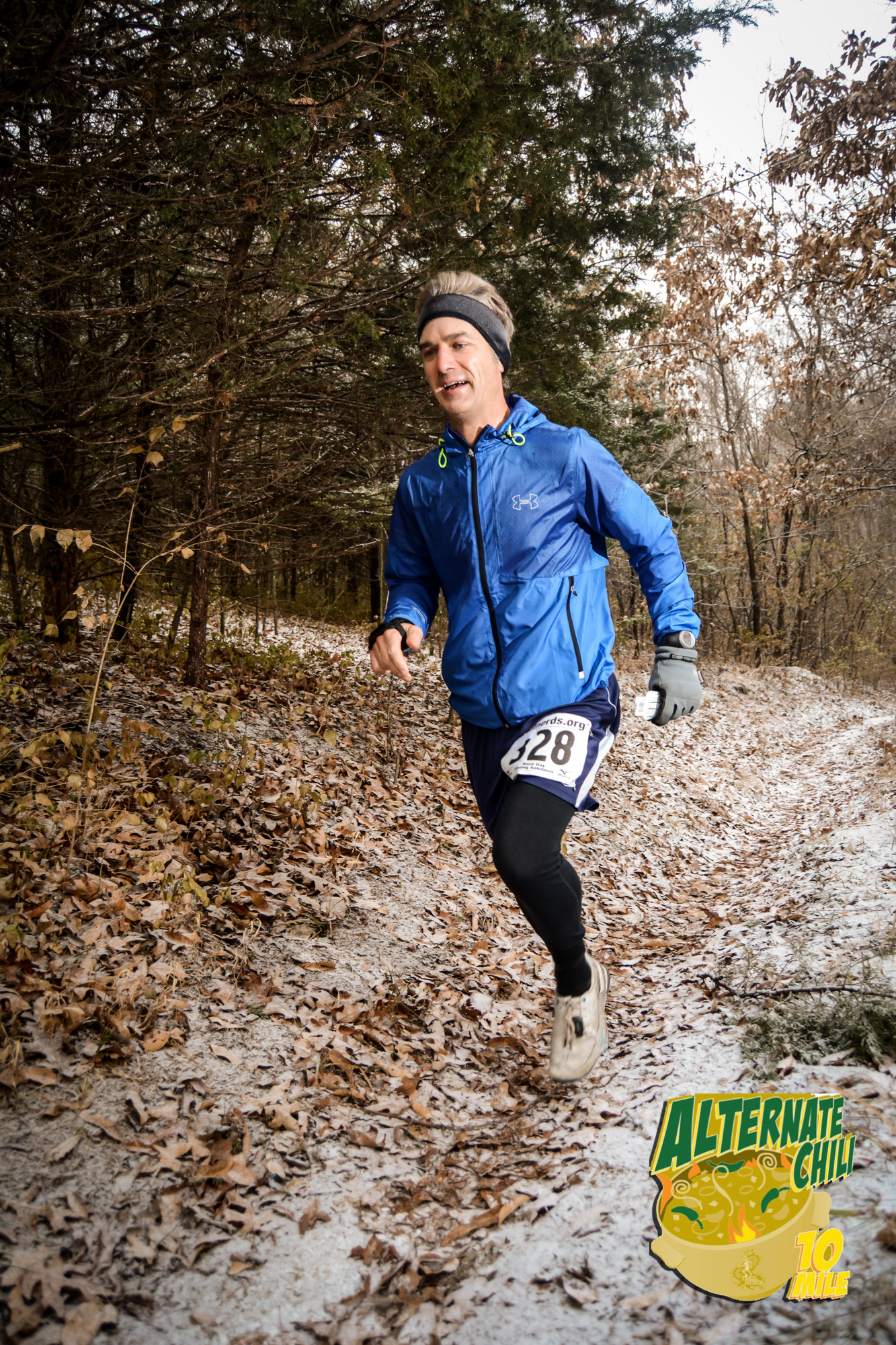
So, how did they work? Great! 10.35 miles over some extremely hilly, rocky, slippery terrain. ZERO FALLS! I fall all the time on this trail in good weather. The day before the race we had some freezing rain followed by rain into the evening, which switched over to a light dusting of snow (less than an inch) but just enough to cover everything and hide the bad spots.

You’re going to lose a few screws. It’s a tradeoff – you don’t want the screw poking through into your foot. I think (but haven’t actually verified) that 1/4″ is as long as you can go without doing that. My lost screw count was 3/10 on each shoe. The lost screws were symmetrical too:

2013-12-16_07-57-52_308

Happy winter running!

altchilirun-2013-9695

My stats: 20th overall out of 150; 3rd male 40-49; 1:37:07; 9:43 pace.

A few more miscellaneous tips (not related to screwing your shoes):

I smashed the palm of my right hand pretty good while pacing the OT100 in November. Fearing a reinjury (I still have a twinge now and then) I decided a little protection was in order. Luckily, being a Gen-Xer, I had some dusty rollerblade wrist guards in my closet. I busted them out and wore just the right wrist guard.

2013-12-16_08-02-32_618

Since this was a last minute thing, I forgot that gloves wouldn’t fit over this. With a 15mph wind and sub-freezing temps, I wished I had some mittens, but left them at home. If only I had a sequined glove for my left hand… I did have my Alba un-petroleum jelly with me though for my nose and cheeks, so I slathered some all over the exposed skin on my right hand. It was as good as a glove!

2013-12-16_08-02-36_473

20 THEODORE KARDIS 328 OLATHE KS M 43 M 40-49 3 18 1:37:07 9:43

Yikes! Winter Training begins soon!

Thanks to a tweet, I was reminded that the Boston Marathon is 20 weeks from today yesterday. That means if I’m going to start an 18 week training plan, it starts December 16th. I knew it was coming… putting on the calendar makes it real though!

So, the question is: how should I train this winter? I’d love input.

Option 1: The advanced marathoning 18 week, 55 mile week peak plan. This is the plan that I used for the KC Marathon in October. Thanks to this plan, and an injury-free year, I’ve blown away my past mileage training totals. My feet have been doing really well – which I attribute to the anatomically-correct Skoras I’ve been running in primarily in the second half of the year. The arguments against this plan are first, that I was well off my PR (-6 min) at the goal race. Also, it will be hard to put these miles in during the winter months. The argument for it is that it didn’t get a fair shake (i.e., I didn’t give it a fair shake). I ran a September marathon 5-6 weeks prior. I was also involved in some fairly radical (for me) diet experimentation leading into both the September and October races. I switched from ketosis back to glycogen dependence just 3 weeks before the race, and I gorged on fine food at Disney the week before the race. C’est la vie.

Option 2: A lower mileage plan. TBD. I could simply replace some of the medium effort, medium distance runs on the AM plan with cross-training. E.g., run 3x a week (cross-train 3x, rest 1x) instead of run 5x (cross-train 1x, rest 1x), subbing in cross-training for those runs. I’ve done this before successfully. The argument against this plan is less running means less goal-specific training. The argument for it is that my PR came in April at Garmin after a winter of heavy cross-training substitution into a running plan. My use of the AM plan had another failing: the “leveling effect.” This is the key to mediocre training: too fast on the slower target pace runs, too slow on the faster target pace runs. With this option, I won’t have the “I ran pretty hard yesterday” excuse going into the faster tempo workouts.

Option 3: Suggestions?

Pacing at the OT100 in Skora Form: Intro to Ultramarathoning #RUNREAL

I paced the last 35.2 miles of the Ozark Trail 100 Ultramarathon this weekend. Darin Schneidewind, the guy I paced, came in 3rd! I take absolutely zero credit for his podium, but I had a great time coming along for the ride.

The RD credited me with my first Ultra. Technically, he’s correct. The definition of an Ultra is any race distance longer than a marathon. It doesn’t count if you keep running to get to the chocolate milk at a marathon though, since it’s not part of the race course. A 50K (31 miles) would count, although 50 mile and 100 mile events are what really qualify in my book. Side note: I just saw an announcement for the Tahoe 200 next fall. Yep, that’s 200 miles. 100 hour time limit. For those who feel like they’ve got a little left in the tank after 100 miles.

Here’s the Cliff’s Notes version of my impressions of the race and what I learned:

  1. Running for over 7 hours in the dark was really fun!
  2. Make sure you have lots of batteries and decent gear. See #1.
  3. The Ozark Trail is really pretty, but less so in the dark.
  4. It’s rare to see other runners on the course after 70 miles. Less than 50 runners were left at that point in the race. Amazingly, 4 runners finished within 10 minutes of each other – that was the spread from 2nd to 5th.
  5. Counterintuitively, it’s easier to follow the trail at night.
  6. You’re going to fall down. It hurts. Get used to it.
  7. Your pace is slower than a road marathon, but it’s no walk in the park. The vast majority is running, but there is some walking – if you can call a brisk hike up a steep hill walking.
  8. It helps mentally to break the run down into the smaller manageable increments between aid stations. Those “manageable increments” are still over an hour each.
  9. I’ll have to multiply what I did by 3 to run a true 100 mile Ultra.
  10. The people at the aid stations are truly excellent folks. Not a lot of spectators out there. No cheering crowds at the finish either, if that’s your thing.
  11. Ultras aren’t really a photo event. Nobody’s hiding in the bushes at mile 83. Or at the finish for that matter that I could tell.
  12. Cool fact: you can’t sleep after an Ultra since your heart rate stays up after being up for so long (didn’t affect me, but I didn’t run all of it).

For mind-numbing detail about Ultra-outfitting and my race report, read on!

Gear: I give myself an “D-” on this one. I was a victim of my own cheapness. I had two cheap headlamps and a serviceable handheld flashlight. The cheap headlamps were too bouncy to wear. I knew this ahead of time – I was going to use them as backup handhelds. I stuffed one in my pocket and left the other with Julie in case I needed to swap out. I had one set of batteries in the flashlight and a spare set with me. The first set ran out part of the way through a segment and I had to switch to my backup headlamp. The flashlight threw great light on the trail when it was working. The headlamp did not – way too dim. I got my spare batteries in the handheld at the next aid station and was good to go again. However, in the next segment disaster struck. I fell and crushed my flashlight AND my headlamp. Not to mention deeply bruising my palm. The flashlight was working intermittently, so it wasn’t the bulb. The headlamp came apart, and a battery flew out. I couldn’t find it and didn’t want to spend any more time looking. Darin had a spare battery, but I couldn’t get the thing going again. Fortunately he had a working headlamp and flashlight, so he gave me his headlamp for the duration. I’m very lucky both of our lights worked to the end, since I was out of options. I did put some new batteries in my flashlight at the penultimate aid station, but I didn’t want to distract Darin by trying to give him his headlamp back and then have to ask for it again if the flashlight wasn’t really working. The only thing I got right with my gear was my Garmin(s). I wore my 2-year-old refurbished (under warranty) Forerunner 405. I was fairly certain it wouldn’t make it to the finish. As it was, it didn’t start chirping low battery until the last segment. Fortunately, I had my wife’s Garmin Forerunner 10 with me too, and I had it rolling before my primary shut down. Hers isn’t as accurate as mine – thanks to my recent addition of a foot pod, but at least it was good enough to give us some idea of elapsed mileage. I reset my Garmin at each aid station so I could let Darin know how much mileage was left in each segment. He was wearing one of those humongous O.G. Garmins – the GPS equivalent of a bag phone, but favored by many for its long battery life. His lasted for 90 miles, which would have been around 16+ hours. Mine only went for about 33 miles and 7 hours. Lessons learned: buy decent gear; have a backup; bring plenty of batteries.

Clothes: My grade is A- on this. I know running gear pretty well now, as well as what works for me at different temperatures. I wore a L/S Compression Nike Pro Combat Cold Gear up top, with some Merino Wool tights on the bottom. Thin wicking socks. Liner gloves. I tied a L/S fleece around my waist in case I got cold, and had a fleece headband in the pocket just in case. I never needed either. The top was running a little hot, but not by much. I started right at dark, about 7:45pm, so falling temps, not to mention colder in the hollows. I think the air temp was probably upper 30s to very low 40s at the start. It was below freezing by the time we wrapped it up 7 1/2 hours later. I changed my shirt once. Wow, did that dry shirt feel fantastically warm and cozy after a few hours in the first one! I also changed socks once after a dunking at a water crossing. I didn’t have any problems per se with socks, although in hindsight I would have thrown a pair in a pocket so I could have changed at an earlier aid station before the crew access point where Julie gave me the dry ones. I also had a huge variety of other things to change into in my gear bag so I could have switched to a lighter L/S shirt, added a vest, gone with a S/S shirt under a fleece, etc. However, I never needed any of that. A combination of Body Glide and petroleum jelly in various strategic places prevented any chafing/bleeding nipple issues. Lesson learned: if you’re running the whole thing, take advantage of drop bags, even if it’s just socks and batteries.

Shoes: A on the shoes. My Skora Forms worked great. I had taken them for a 20 mile spin on the trails at Clinton before this, so I knew they’d do well. I had ZERO foot problems after 7 1/2 hours and 35 trail miles. I attribute that to the anatomical design of the Form, coupled with my trick of coating my feet with a thin layer of petroleum jelly before socking up. I reapplied once during the race. No blisters. No lost toenails. I have never lost a toenail in minimal shoes. Do you hear me, heel strikers? Also, there’s nothing that’s significantly absorbent on the shoe, so I didn’t pick up weight after getting them wet. They drain well and the leather upper handled the moisture well. I knew they’d be fine though, since my trial trail run in them was in the rain. I brought a spare pair of shoes (Base) just in case there was some train wreck issue with water or shoe failure, but I didn’t need them. Lesson learned: punish your shoes before a race to make sure they work they way you need them to in a worst case scenario.

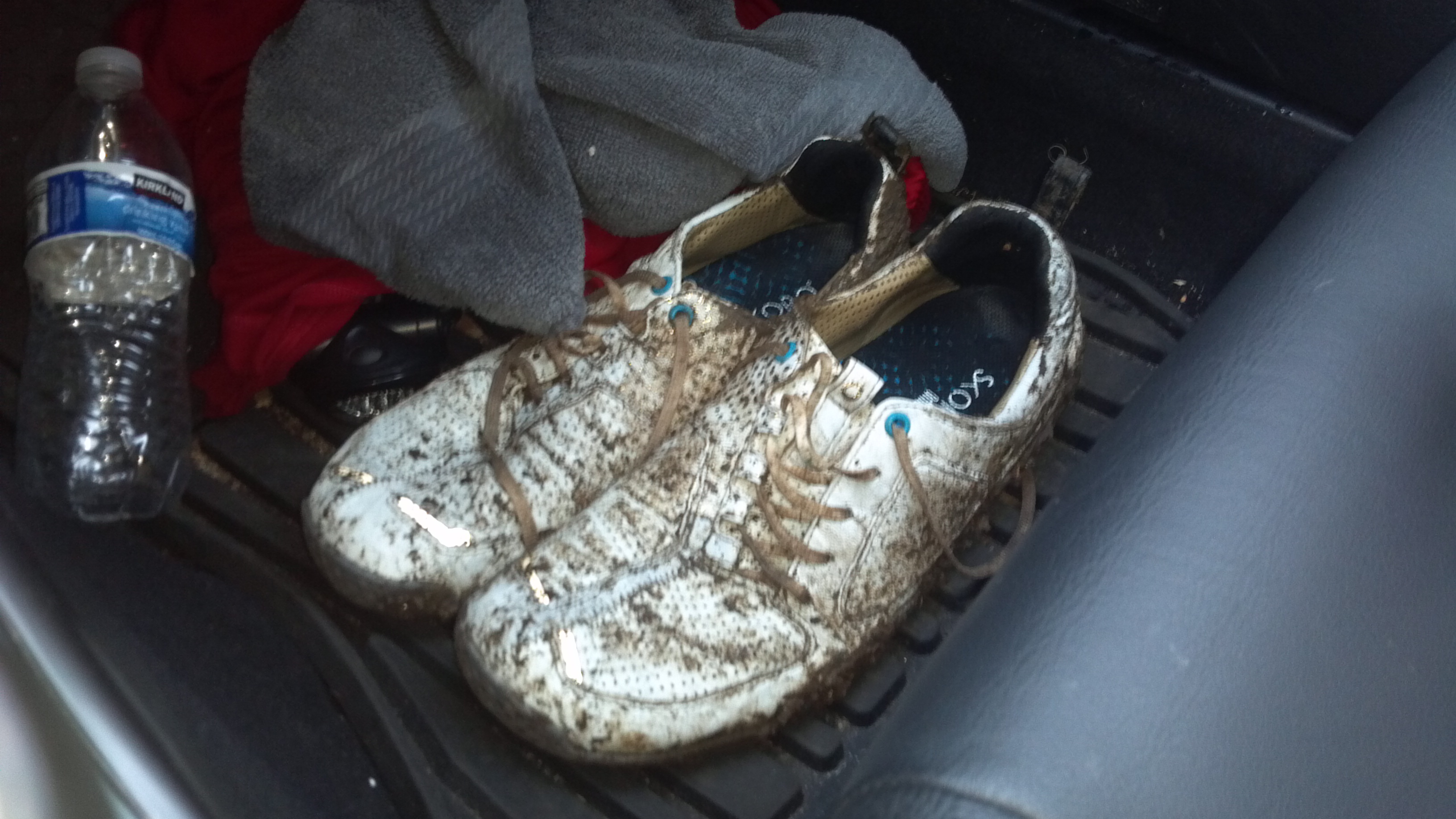
Since I don’t have any race pics, here’s my Forms the day after:

2013-11-04_07-38-12_840

Fueling/hydration: I give myself an A here too, by virtue of having no issues whatsoever with this. I really can’t recommend one of my pre-race meals (a breakfast of Krispy Kreme donuts). However, I ate a hearty late lunch, including some delicious lobster and shrimp bisque, a salad with beets and goat cheese, some pan-fried tilapia, and steamed veggies. Oh, and some ice cream for dessert. Props to “Sybil’s” in St. James – a welcome surprise on the way to the race. It sat well and I had plenty of time for digestion before the race started. When Darin came into the tent, I pounded through a roll of Sweet Tarts. I had been pushing fluids all day until my urine was clear. I gulped down 2 cups of HEED before we started. I hate carrying fluids with me. I did fine with 2 cups of HEED at each of the next 4 stops before the finish. I wasn’t ever truly thirsty, but I may have to reconsider this strategy of aid station-only fluids if I run a full Ultra. I refueled mostly with candy bars and HEED gels. I never felt nauseous or had any other GI issues. Lessons learned: drink when you’re thirsty. Make sure you’re okay with what’s being offered at aid stations.

It’s going to be hard to reconstruct a description of the course and race from memory, especially since it was dark, but here goes.

I started at Hazel Creek – 68.4. This was a crewed aid station, so lots of people were there. Darin came in a little past 7:30pm or so in 4th place and this was a major stop for him – changing into night clothes, eating, shoe change. I was chomping at the bit to get going! I admit to being a little disconcerted when Darin mentioned that he had gotten off course by about a mile earlier in the day and had to retrace his steps. I tried not to show it. Later, I realized it is much easier to follow the trail at night. First, it’s packed, so if you get off it, you can feel the softer ground underfoot. Second, the trail markers have a reflective square on them that can be seen from afar. It’s really helpful. Darin and I left the aid station with the 5th place runner and his pacer close on our heels. We eventually put some distance on them and they never passed us. This stretch had some really marshy spots in it – I soaked my shoes pretty early on. We came up on the 3rd place runner in this stretch. Darin knew him by name. I appreciated the friendly exchange between the two. He asked if we wanted to come around, but Darin said not yet. He meant it too, as we took a breather and let him go out ahead again. He led us into the first (for me) aid station at Pigeon Roost (75.9). There was a gravel road – pretty much the only part of the run that wasn’t on single-track trail – for a half mile leading in. It was mostly downhill – it felt like we were flying! I worried I was pushing Darin too hard – but he knew his own mind already and told me he was going to back it off a bit as we cruised toward the aid station. I seem to remember an inflatable snowman – it was too early for hallucinations so I’m pretty sure it was really there.

The next stretch was a relatively short 5.4 miles to Berryman campground. We did it in just over an hour. This is the segment where Darin moved into 3rd place for good. It sounds stupid, but since it was dark, my favorite part was a touch of civilization – a huge swath cleared out for high power lines. It was strange to suddenly to have the sense that there was nothing around or above us. The stars were brilliant as well, made brighter by a new moon. Berryman is a crew access point, so Julie was there, along with a bunch of other people and a lot of Christmas lights! I got to switch out my socks and shirt, but Darin was quicker through here than I expected! I was still pulling my shirt on and grabbing candy bars as we headed out.

Berryman to Billy’s Branch was a long haul – 8.8 miles that took us almost 2 hours. We met another runner coming out of Berryman – it’s the only part of the race that’s an out and back. There is a short spur in and out of the campground before the trail took off to the right again. Seeing the other runner motivated Darin to push really hard during some nice flat stretches of trail. Billy’s Branch was a welcome sight – especially for Darin, he knew the folks manning it pretty well. Unfortunately for me, there’s a really tricky narrow and steep section coming into it, and I stepped off the trail onto a slope and sprained my ankle. Ironically, just a few minutes before this Darin had taken a wrong step as well and remarked about NOT spraining an ankle. If only I had been so lucky! I ran through the pain, including 3 or 4 re-tweaks on roots. Eventually it loosened up (or swelled up, or whatever your body does to keep moving if it thinks it has to) and I was running well again, albeit not totally pain-free. There was a cowbell coming into Billy’s Branch – which we used to our advantage after leaving to learn that we had about 2/3 of a mile lead on the next runner behind us. More cowbell!

Because of my ankle, the worst stretch for me was the 7 miles to Henpeck Hollow. However, we ran it at a really good pace, about a minute per mile faster than the previous segment. Darin was killer on the downhills, despite having some pain in his quads (understandable at the 90 mile mark). With my ankle, I had to push to keep up. At this point in the race, we never saw lights behind us, maintaining our lead on #4. However, we never saw #2 either. As we came into Henpeck, Darin made it clear it would be a grab and go to keep our lead to the finish. I think he might have taken on some bacon. While bacon is probably one of my top 10 favorite foods, I’m not sure if I would feel that way about it after 97 miles.

The last segment has 3 significant hills. Darin ran really strong to the first hill, which didn’t appear until a couple of miles into the last 6.5. Ironically, the only time we went off course was right before the finish. As we came into the campground we were seeing a lot of glow sticks, however, we missed a turnoff that was marked by a reflective sign above eye level on a tree – not more than half a mile from the finish. No glow sticks there… Fortunately for Darin, he had run the course before and knew something was off when we found ourselves on a paved road in the campground. I ran back to retrace, but he figured it out first and we brought it home after finding the turn.

After getting into the tent, we learned that second place hadn’t been in the barn for long – and we saw the fourth and fifth place runners come in together about 5 minutes after we did. Thank goodness we didn’t wander around the campground too much!

I came out of this race amazed at how clearheaded Darin was and how strongly he was able to run during those last 35 miles. If I venture out onto this course myself next year I hope I can keep it together that well.  I don’t know if doing the whole thing would change how I feel about it, but I had a lot of fun running in this race!

Skora Phase shoe review & Kansas City Marathon race report #runreal

This past weekend’s Kansas City Marathon was my first race in the Skora Phase. I didn’t have the Phase in time for Heart of America in September, or I would have worn it then. It’s lighter, and I prefer the laces.

This was my sixth marathon. I’ve run all of them in minimal shoes. This is the first shoe I have run in that did not produce any blisters whatsoever over the marathon distance. I rarely have blistering problems during training runs, but it was not unusual to have a blister or two at this distance and pace. But no blisters is way better. I had worn the Phase on a 16 mile long run, and couldn’t wait to put them on for the marathon.

The Phase is so light I’d say it’s nearly in the realm of a racing flat. 7.2 oz. to be exact. It’s similar to the Core, but with a synthetic mesh upper. The sole is injection blown rubber. Zero drop. Also, mine have an awesome color scheme – red, black, yellow, white. My son Cole calls them my “Chiefs” shoes. I might have worn them to a game.

A snug heel, asymmetric lacing, and an ample toe box combine for a fit that allows your foot to be itself. You never feel like you are moving around in the shoe in a way you don’t want to. The Phase disappears – my definition of the ideal shoe.

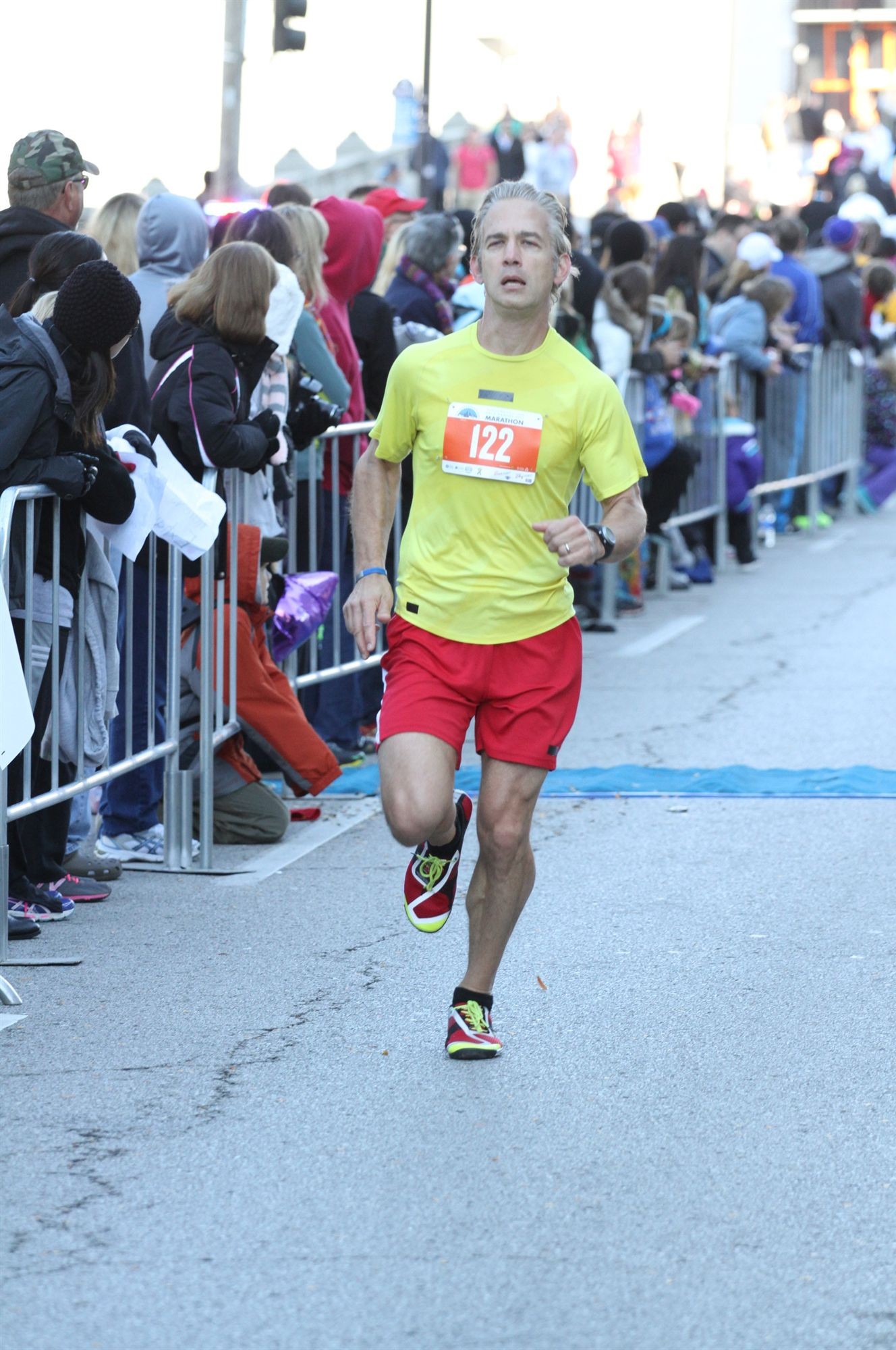
Here’s a shot of the Phase (with me in them) on the course:

OLYMPUS DIGITAL CAMERA

I have to admit I wasn’t peaking for this race. Some diet experimentation in August and September, coupled with a week of gluttony at Disney World the week before race week didn’t make for ideal preparation. I did not have a hard time goal for this race because of these factors. In my experience, going into a race without a specific goal you are striving to achieve is a recipe for mediocrity. I always perform better when I am reaching.

My plan was to go out with Nelson and try to encourage him to a BQ. We started with the 3:15 pace group, but he took off and ran his own race from about mile 2 on. I had him in sight for a while, but then settled into the 3:15 pace group. Pace groups can be a double-edged sword. At times, it’s great to tuck in and just follow the herd without having to think too much. However, there are lots of factors that might draw you off from the group. For me, there always seems to be some point where the pacer is pushing too hard to make up a particular time goal on a stretch. That might be just my imagination though!

I stuck with the 3:15 pace group through the halfway point and most of the way down Ward Parkway. They picked up a second pacer, and the first one dropped back to try to bring me up with the group. Very cool. I could feel that it just wasn’t my day though, and I cut him loose. After a mile or two, I noticed I had my friend John in sight. It took me a while to catch him – since I didn’t want him to feel like he had to drop back to me I didn’t call out. His family was waiting for him just before the turn onto 75th street. I caught him just as he stopped with them, then he caught back up to me. We ran together for several miles, then he made a “pit stop.” I was amazed that he caught back up to me and then told me he was going to try to go out and catch up to the 3:15 group. Not only did he do that, he passed them, caught and encouraged Nelson, and beat both of us to the finish! Way to go John!

I ran a good portion of the race by myself. However, when I got to the top of the hill at the Armour/Paseo turn, I felt a surge of energy. I had slowed in the past few miles, but I didn’t feel like I had hit “the wall” as I have in some past marathons. From mile 23 on, I really picked up the pace. There was a guy that I had been passing back and forth with the whole race, and he was flagging. I tried to pay it forward and encourage him to come with him. We ran together for about two miles, until the final mile. Then I dropped him with a kick since I was feeling so good. The kick made me think I had left some minutes on the table.

There were some changes to the course this year, and my favorite was a straightening out of the last 1/3 – 1/2 mile of the race on Grand. It used to make a couple of turns from 18th to the finish. Now it blazes on over to Grand, and you can see your target off in the distance as you head down a nice downhill stretch before the final “bump” (overpass) leading into the flat finish. The new course really helped me crank it up a notch in the last mile. I even passed a couple of runners on my way to a respectable but not great time – pretty far off my PR but not my slowest effort either.

Nelson held on to his lead on the pace group for a time of 3:14:21. A BQ! Way to go!

The Phase will be my go-to racing shoe from now on. It checks all the boxes – great fit, light, zero drop, enough cushioning to cut down on the road noise but not so much to drown it out, and it doesn’t hurt that it looks cool. Never underestimate that psychological boost!

By the numbers:

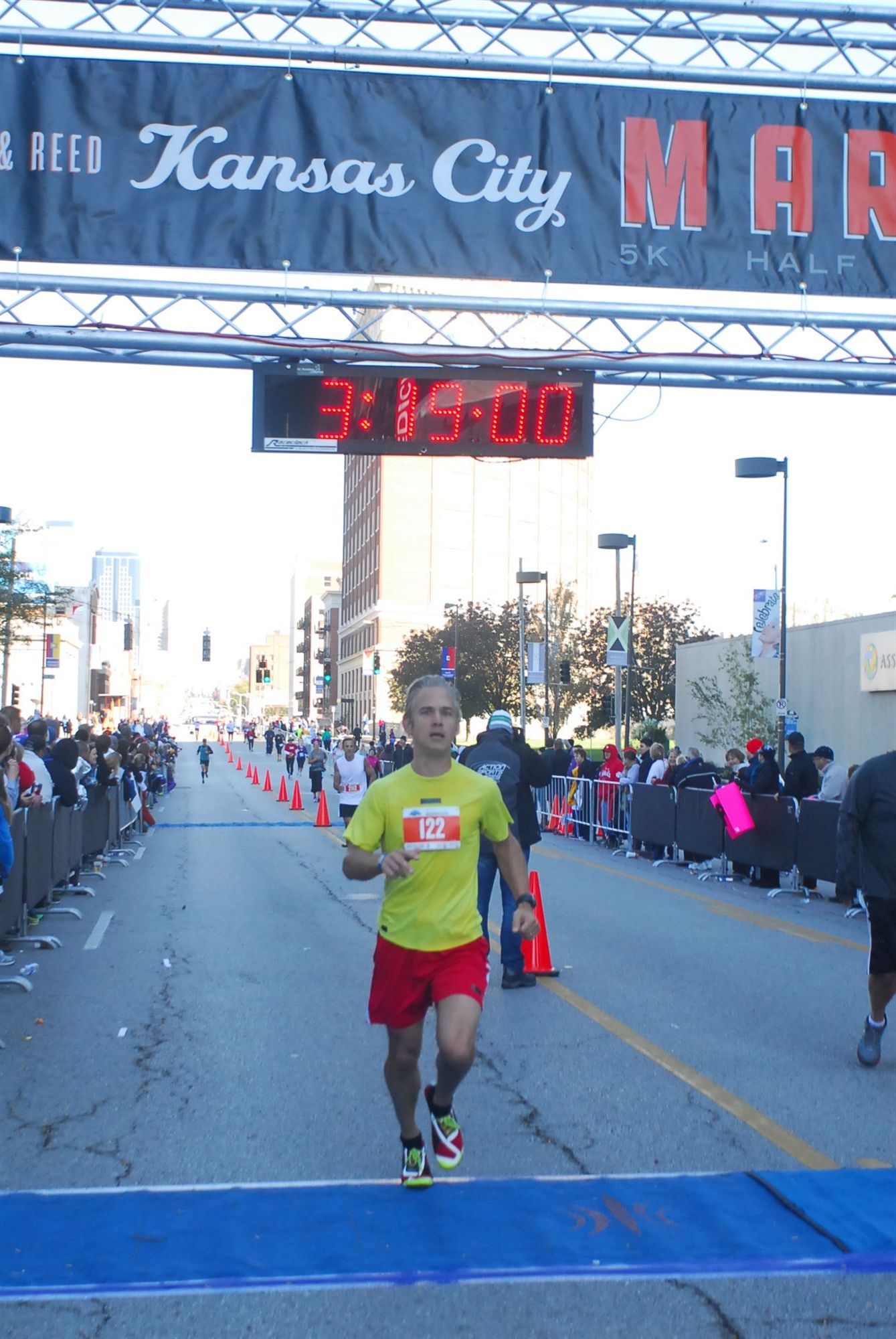
3:18:52

78th overall

5th in M40-44

overall pace 7:34

Here’s a few more pictures:

OLYMPUS DIGITAL CAMERA 120588-1213-012h 120588-451-021h 120588-451-020h 120588-055-032h 120588-005-012h

Disney World at marathon minus one week = #tapermadness

One way to make sure you’re tapering enough before your fall marathon is to take a vacation right before it!

Yes, I know taper madness properly refers to that stir crazy feeling I’m supposed to be getting by reducing my mileage in the 2-3 weeks leading up to a marathon. Of course I’m not seriously advocating this vacation over-tapering as a strategy for running your best, but there are times when something has got to give. I try to place family before running.

I’m running the Kansas City marathon 10/19. We left for Disney World 10/4 and returned 10/13 (we drove). 10/6 began 6 days of gluttony. Disney has some great food, and I ate my fair share of it. In addition to walking all over the place while at the parks, I did get in 4 runs over that stretch. Not exactly according to my training schedule, but not entirely off the wagon either.

So, while I don’t think I am at peak fitness for this race, I feel good about going out with Nelson and the 3:15 pace group. He is going to pull away at the halfway point. I will try to go with him. I don’t think that will be a problem – like most people I am feeling my best at that time. It’s the final 6.2 that will determine the price I will pay for overindulging last week! I am just going to try to enjoy the race and encourage Nelson to a sub 3:15. He’s had some great training runs and he’s healthy – he should crush that time! John, my other running buddy 10 years my junior, is dealing with a foot issue, but is capable of a 3:00 marathon or better. I don’t think I’ll be trying to stick with him this time around, although it would be great to have someone pacing to a sub 3:00 – one of my “doable” goals. Maybe next year!

I boosted my confidence a bit with a “dress rehearsal” run tonight – just 6 miles, with 2 at “race pace.” I suppose that is going to be 7:14, but I actually felt really good tonight and I went under 7:00 for both of those miles. I love the cooler weather – cool means speed!

Minimalist trail running in the @Skorarunning Form

I went on a 20 mile trail run in my new Skora Forms this weekend. Until Saturday, this was the only shoe in the Skora lineup I hadn’t tried. I was eager to check it out after I realized it was probably the shoe best suited to the type of trail running I was planning.

The trails in my “neck of the woods” include some extremely rocky sections, mixed with dirt single track. According to my personal subjective definition, a light trail is predominantly dirt, maybe some small gravel. I could run a dirt trail barefoot, but when you mix in some rocks, you need some degree of protection.

The Skora Form is the sturdiest, most durable shoe in the minimalist Skora lineup. With a 13mm stack height (zero drop), a rubber/EVA Foam outsole/midsole, and a goat leather/perforated sheepskin upper, the Form can take whatever your trail dishes out.

To my way of thinking, the Form has just enough minimal cushioning to handle a rocky trail without being too much. I was able to take it through some really uneven ground without feeling like I was beating my feet up.

My 20 mile run at Clinton Lake got off to a great start, in the dark at 6am in a fairly heavy rain – I’d call it just shy of a downpour. Thankfully temps were still in the 60s. Heading into the woods helped calm things down, and while my clothing was pretty wet, my shoes weren’t soaked, although they were wet. I never had the feeling that the Forms increased significantly in weight due to water during the run, which had rain on and off most of the 3 hours I was out there. I stopped for a re-tie at the 1 hour mark – I had tied dry, plus it was my first run in the shoe. I didn’t have to mess around with them any more for the final 2 hours – fit was great for the rest of the run. Anticipating the rain, I rubbed in a light application of petroleum jelly on my feet before putting on socks, then the shoes. That, combined with good fit, meant no blisters as a result of this run. I’m very pleased with that, given that my feet were wet the entire run.

The Clinton Lake course is full of rolling ups and downs, but on balance I’d say it doesn’t have the really steep killers like Wyco Lake Park. Despite terrible conditions, the Form had enough traction to keep me vertical even on wet rocks and through the mud. Yes, there was mud:

2013-09-28_10-17-20_172

They are a lot prettier when clean…

I’m primarily a forefoot/midfoot striker. I like that the Form has enough structure in the heel that if I want to take a break and heel strike a downhill, I’m not paying a price for it. It’s shaped like your heel – curved, not flat.

Something I keep coming back to with Skora’s line of minimalist offerings is that the shoe just gets out of your way and lets you run. The Form was no exception. Other than thinking about the fact that I was evaluating the shoe while running in it for the first time, my attention wasn’t drawn to the shoe. To me, that’s ideal. No slipping, no hot spots. I was simply able to concentrate on negotiating the best path on the trail.

I’ve done a slightly shorter trail run in the Core on a different course (Wyco). I felt a bit beat up by that trail. I think Core is excellent on a light trail, but for the hard rocky stuff I’d go with Form. It’s worth mentioning that the Core is probably one of the most comfortable shoes I’ve ever put on my feet. For a light trail, or running in grass (e.g. one of my suburban just-off-the-sidewalk courses) the Core can’t be beat. However, from now on, when I run one of our typical exposed-rock mixed surface trails, I’ll be lacing up my Forms. Can’t wait to hit the trails again in them.

Partial objectivity disclosure – I spent my own money on these shoes, but at a Skora Ambassador discount.

#ketogenic diet: the experiment concludes

As I tweeted last Thursday, I called it quits after 6 weeks on a ketogenic diet. Basically, I decided to go back to carbs because I just didn’t feel like tolerating the valleys anymore, along with a near-constant feeling like I was at 80%. Being on carbs means feeling 100% most of the time, with the occasional low spot, easily cured by a quick hit of sugar. Being on fat means 80% most of the time, with an expected evening dip. The only time I didn’t feel at 80% was when I was exercising, or for several hours afterwards, presumably because that’s when my ketone production was cranked up.

I terminated the experiment just 3 weeks out from the KC Marathon. I would have liked to assess performance there while fully keto-adapted, but I just couldn’t stomach (pun intended) the thought of going to Disney with my family and saying no to all the stuff I am going to want to eat there. Disney has some excellent restaurants, and we have long since had reservations set up for them. Plus, I just wasn’t sure I’d have the energy level necessary to go 18 hours a day there like we usually do. Even with those excuses aside, I really didn’t feel like 3 more weeks of it regardless, even in an easier setting.

I’d like to run well at KC. It’s hard to say what the diet has done to the 4 weeks after Heart of America from a training perspective. I don’t know that I have either gained or lost any fitness during that period. There hasn’t been as much speed work as I would like during the last month. It feels like I have been doing a lot of medium intensity, medium length runs. I can comfortably say that I feel like I have enough time to switch back over to carbs before 10/19. I’ll be trying to toss in a lot of fartleks during the taper, which began this week.

Yes, there has been some sugar binging in the last few days. (mmm, donuts). I think I’m ready to move on now. I’m going back to semi-Paleo (meaning plus dairy, with one cheat day per week).

When your #BQ isn’t

Last fall I ran a 3:13:55 at the 2012 KC Marathon. I was elated – finally a BQ after 2 unsuccessful attempts! However, soon after posting that time, I ran across a blog that informed me, much to my horror, that a BQ didn’t necessarily mean you’d be running the race. Boston has a double-secret (ok, it’s not actually secret) cutoff time that is only established after all registrants submit their names. I don’t recall what the cutoff was for which prior year, but I do know that one of them was in the BQ-1:30 range, i.e., if you didn’t beat the BQ time for your age by 1 minute, 30 seconds, you weren’t running.

Since I had a BQ-1:05, I knew that I once again had a time that probably wasn’t going to get me to Boston. (In my marathon “debut” I put up a time that would have got me in under the old 3:20 standard but I ran it about a month too late to register for 2012 . Since registration was closed, it wasn’t good enough for 2013).

With that in mind, I attempted my first spring marathon, the Garmin Olathe Marathon in April 2013. It can be very hard to train for a spring marathon during a Midwest winter. I put in the work, and my reward was the 3:11:03 I needed to beat the BQ-1:38 cutoff for 2014. That race came just one week after the senseless bombings at Boston 2013. I never doubted that there would be a Boston 2014, but it was to some degree an open question in the aftermath. I was unashamedly emotional at the finish line of Garmin.

In hindsight, I’m glad I didn’t let off the gas after KC 2012. You never know when you might need a few more seconds.

#ketogenic diet: week 5

I’m at the 5 week mark today. This week went MUCH better than the previous one. After a real low spot leading into the 4 week mark, I was getting discouraged. However, after re-emphasizing fat and trying again to make sure I didn’t over-emphasize protein, I felt much better. Two more tricks have been 1) trying to make sure I get enough salt (thanks, bullion cubes!) and 2) a Fourthmeal/snack about an hour before bed. Altogether, I have had much more energy upon waking, and I haven’t had any malaise/run-down feeling this last week. It had been getting particularly bad in the evenings. So, it looks like I’ll try to keep this up at least through the KC Marathon to see how it affects performance!

“Fun” with numbers – my #BostonMarathon chances! #runreal

With the announcement today that 7500 people signed up for the 5000 spots left, I decided to see what number I am sweating by the end of this week. So, fun with math. Engineers: feel free to correct me if I’m wrong. Btw this is based on the assumption that the times submitted are equally distributed across the 5 minute range.

My time is a 3:11:03 (a BQ-3:57 for the 3:15 cutoff). Using the BQ-3:57, that means I’m in the 79th percentile for the 5 and under group.

There are 5,000 spots remaining. So, solving for x in this equation should yield the number of equally distributed registrations that cannot be exceeded for my 79th percentile time not to make it:

x – 5000 = .79x

If you want to use this equation for your own time, figure out your percentile and put it in the spot of the .79 in my equation. I’m not going to show my work. Plus, I cheated and used an equation solver. But I did make up the equation myself. Could you smell that burning smell?

Solving for x yields 23,809. So, if more than 23,809 people register this week, I won’t make it, since 79% of 23,809 = 18,809, or 5,000 less than 23, 809.

My head hurts.