By the numbers: #milleniumclub and #ketogenic diet

I realize this is kind of a “yay, me” post, but I went over the 1000 mile mark for 2013 today on my am run. No, I didn’t go to a strip club, as the title may suggest. That number may not seem like a lot to some, but it’s an all-time high for me. I was in the 900s in 2012 and 2011, the latter being the first in which I first upped my mileage into the marathon training range. Prior to that I was a casual 5 miles, 3 or 4 times a week.

A quick ketosis update too: another low spot last night. I was feeling REALLY lethargic and discouraged. The RHSW suggested I check my levels, the result: 0.3. Not good. So, I ate a small fourthmeal of a hunk of cheese and some cole slaw. I checked fasting this am, and hit a 1.7. I felt better on waking, but still felt like I was struggling during a pretty fast (sub 8) 6 miles with Jeremy, followed by a 1 mile cool-down. I suspect that I may not be eating enough fat, or too much protein, or a combination of the two – despite my considerable efforts to push fat. I am at the 4 week mark. I am going to give this thing two more week and then make a decision on whether to go forward or punt. If I haven’t kicked the malaise by then, I’m not sure this is going to work for me. If so, I’ll go back to my semi-Paleo diet but return to the ranks of the carb-burners.

#ketones – kinda like diesel

I am nearly a month into my ketogenic diet experiment. There have been some highs and lows. Most recently on Monday – an “off” day – I felt some big-time malaise. Really low energy. However, on Tuesday after going to the gym in the am with the RHSW, I felt really good. Another good day today after 8+ miles in the am.

On my run this morning, I came up with the analogy of how burning ketones in your body is kinda like burning diesel in a car. If you’ve ever driven a diesel, or even just read about them, you know that they don’t accelerate quite as fast as a gasoline-powered car. However, once they get up to speed, they can go much farther than a gas car.

Ketosis feels like this. I’ve never been a morning person, but it seems to make things a bit more draggy in the morning. However, if I take off on a run or work out, that seems to trigger enough ketone production that I coast the rest of the day with a pretty good energy level. I suppose a diet that encourages you to be active every day isn’t a bad thing!

I’m still committed to sticking this out through the KC Marathon to see what performance benefits/detriments it holds after having acclimated (which probably wasn’t fully accomplished for HOA). On the bright side, if it’s a bust, then donuts.

HOA #marathon in @skorarunning Base #ketogenic race report

I ran the Heart of America Marathon on Labor Day in Columbia, MO. The HOA is considered “one of the most difficult nonmountain marathon courses in the nation,” going from downtown Columbia down to the Missouri River and back up. I placed 3rd in my age group and ran the course almost 3 minutes faster than last year. The field had a ton of talent up at the top – despite running faster I came in 23rd – I was 11th last year! Sometimes, whether or not you pick up any hardware depends on who else shows up – even if you have a great day. I ran a 3:19:51.8 – a 7:37 pace. Lucky for me, only two faster guys my age showed up, so I got this:

2013-09-02_12-48-16_342

I wore the Skora Base shoe. I put over 100 miles on this shoe pre-race and was very comfortable with it going in. I’m really happy with how it functioned during the race. I used an Iniji toe sock which kept me from having any blistering or rubbing between the toes. The Base held up great on what is primarily a pavement course. There is a three-mile section of gravel just before midway – although this is actually my favorite surface to run on in the Base. I love how this shoe just disappears – if I’m not thinking about my shoes during a marathon, that’s ideal. You need something on this course with the gravel section and a significantly long newly paved section that is rough, not smooth (I’m sure there is a highway construction term for this). Some guy ran it barefoot last year, but I didn’t hear about anyone trying this year. You would have to go in the ditch on that new section – nobody’s callouses could hold up to it. The Base was just enough without being too much.

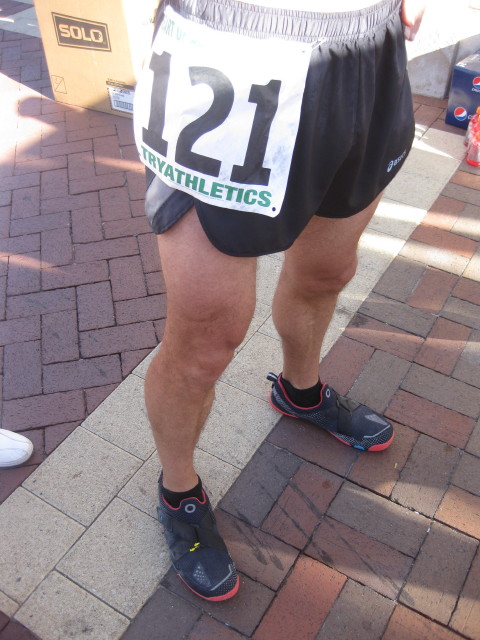
Here’s a shot of the shoes at the finish line:

IMG_5576

This was my first race on the ketogenic diet. I switched over on 8/15, so I may not even be fully keto-adapted. I cut out fiber the day before, eating primarily fat with some protein. Unfortunately, I either went to bed too soon after eating the night before the race, or had some food poisoning. I woke up just over an hour before my alarm was going to go off, and seriously thought I was not going to be able to toe the starting line. Either way, I don’t believe this had anything to do with my dietary switch. I haven’t had any such issues before long runs. Fortunately, when the alarm went off at 4:45, I felt better, so I decided to give it a go. I had two cups of coffee with heavy whipping cream for a bit of fat. I was slightly concerned that I might be low on potassium after eating zero veggies the day before, so I added a 1/4 tsp of No Salt (potassium chloride) to my second cup of coffee. It was one of those spur of the moment decisions. I need to research this more to see how long potassium stays in the system. Too much or too little can be dangerous, so don’t try this at home. I liberally salted food the day before, so no worries on the sodium front – I also had a 1/4 cup of pumpkin seeds the day before for some magnesium. I drank about a liter of water – half when I got up, the other half right before the gun. I ran the whole race on nothing but water. No Gatorade, no gels, etc. Just the fat in my body. The proof is in the pudding – I was a little distracted after the race – lots of friends and family around – but I checked my ketone levels 40 minutes after I stopped running, and they were 5.4 mmol. Definitely “in the zone” and then some, without getting too high.

So, on to the race itself. My plan was to go out at a 3:10 pace and see what developed. I didn’t have any trouble whatsoever keeping that up on the first half of the course, easily hitting my target pace of 7:14 with the exception of mile 2 (a 7:25 thanks to the Providence hill) and mile 8 (a 7:53 on a tough uphill stretch on Old Plank road). I cruised down through the gravel stretch to mile 12.5, an aid station just before Easley Hill. At this point I was on target, but knowing a negative split was unlikely. I jokingly asked the high school kids manning the aid station at Easley if it was all downhill from there, and they corrected me with some horror before I let them know I was joking. I got a good laugh out of them. Easley Hill, just ahead, is the worst of the hills – there is a stretch of about 1/3 mile that is over an 11% grade. Beat that, Heartbreak Hill!

My HOA “mentor” – the amazing Tom May (just a few years my senior, he ran a personal course PR just over 3:01 this year) advises running Easley Hill until you reach the guard rail and your heart rate redlines, then walk briskly while your HR goes down until you can start running again. I did this, and looked back to see some runners catching up to me as I walked. However, when I hit the top and started running again, after a few minutes I had opened up a sizeable gap on everyone who gassed themselves running the 11% grade. Thanks Tom!

Once you top Easley Hill, there’s a feeling that the worst is over – for a while. I had several great miles in this middle section – buoyed my awesome race-chasing cheering section! I was overtaken by one guy I never saw again, and also passed back and forth with the women’s winner and another guy through Rock Bridge State Park.

Mile 20 is completed at the top of another big hill – I again alternated some brisk walking and running near the top of this one, and was rewarded with overtaking another runner shortly after. I never felt a “bonk” per se thanks to the fat-burning – and my next couple miles were back down in the sevens. However, this course has one last trick up its sleeve – the long uphill on Providence to Faurot Field ending at the 24 mile mark. I slowed a bit on this hill and took a quick walk break – my third – about 10 seconds – to get my pulse back. I was the passer and passee on this tough final stretch. There were only a few people in view at this point in the race, but there is nothing that motivates you to keep moving like hearing footsteps. Again, no bonk, although I did notice some generalized tightness developing in my leg muscles in mile 25. Thankfully, no calf cramps, as I have occasionally experienced in the final 6 miles. I managed to kick it back up to target pace for the final 0.6 as I came onto Broadway. I love how you can see the finishing chute from a fairly long way off at HOA. Simon Rose – a local media personality – was announcing finishers. I played soccer against him when I was in law school – I should say football though as he’s from Manchester! The crowd was really loud and enthusiastic at the finish – what a great reward, topped off by having my immediate and extended family there for hugs and photos. I also reconnected with Tom May and Andy Emerson, another local runner (tops in my age group – I believe he had run Leadville 2 weeks prior!).

The sense of community at this race is capped off by the pizza party and awards ceremony at Shakespeare’s after the race. I abstained from the carbs – barely…

HOA – I’ll be back!

Nutritional #ketosis begins!

Since I’m at the 2 week mark, I tested my fasting blood ketones this morning. The result: 0.7 mmol. I’m relieved by that number.

“a therapeutic range of blood ketone levels for an athlete starts at 0.5 millimolar BOHB at the lower end and improves up to 3.0 millimolar.”

Phinney, Stephen; Volek, Jeff (2012-06-15). The Art and Science of Low Carbohydrate Performance (p. 91). Beyond Obesity LLC. Kindle Edition.

The optimal zone is around 1.5 to 3.0 millimolar, but I’ve read that it can take up to a month to get there. I’m going to do a few more fasting tests before Monday, then also test after my Saturday am run. Granted, that run is just a 5 mile recovery with 6 100m strides, but it’s the most I’ll be doing before the HOA Monday. Of course I’ll test after the race too. Levels should be highest post-exercise.

“Dress Rehearsal” for #HOA in @skorarunning Base; #ketogenic testing; #BostonMarathon

I had a great “dress rehearsal” run in my Skora Bases this morning (brain cramp – just bought my wife the Cores). I did 7 miles with Jeremy and John, 2 at race pace. Pre-dawn makes for some interesting proprioception training! I am ready to roll for the Heart of America Marathon in Columbia, MO, Labor Day.

My ketogenic experiment is going well. I seem to feel a bit sluggish starting out on runs, but once I get going, I am not having any problems. I am experiencing a little more thirst than usual upon waking. The 2 week mark is today, and I am going to test my fasting ketone levels tomorrow morning. I am going to be encouraged if I break 0.5. That is the threshold for nutritional ketosis.

Boston Marathon registration procedures were announced today. The big news is that the field will be significantly expanded, as expected. I hope this means that the secret unpublished qualifying standard (allegedly roughly 1:30 faster than BQ last year) won’t move all that much as a function of both increased supply and increased demand. I hope I will be ok – I’m 3:57 faster than the standard.

The Deep End? My #HFLC experiment begins…

Am I off it? Time will tell. My research into electrolytes and optimal carb loading during the marathon has led me off in an unexpected direction. Nelson has been quoting and recommending Prof. Tim Noakes for some time – mainly his seminal work “The Lore of Running.” I started following him on Twitter a while back, but recently became intrigued by a linked podcast where he was interviewed on the HFLC/LCHF (I’ve seen it both ways, c’mon people let’s pick one) High Fat Low Carb Diet. I also picked up his book “Challenging Beliefs” which has several chapters on the subject and uses the more cumbersome term “high-fat/high-protein/low-carbohydrate diet.” I’m going with HFLC.

This is going to be (for me) a quick post, but the point of this method of eating is getting off the carb/blood sugar pendulum and teaching your body to burn fat with the attendant health and performance benefits (no wall?)

I decided to launch into it Thursday evening. There was a fairly short and fairly mild acclimatization period. My only symptom was a light headache (to be expected from what I read) on Friday. I felt great on a long run Saturday with 12 sub-7:30 miles on my way to 16. It was a depletion run – nothing but water. There was no bonk like I had experienced a couple of weeks before on an attempted depletion run of the same distance. My Sunday morning recovery run found me about 0:30 faster than usual – I struggle with a decent pace on this run although I realize it doesn’t need to be that fast.

With any luck this means my body has happily switched over to using ketones for fuel. I’m still researching what to do during/before a race. Ultramarathoner Timothy Allen Olson eats this way. I am looking forward to listening to a podcast interview with him on the way home today. I figure he’s fairly credible since he won the Western States 100 in 2012! [EDIT: and 2013! Wow. Article with podcast link predated WS 2013.] Wish me luck!

The Electrolyte Debate: What to drink during your marathon?

I’ve previously dabbled in the alchemy of finding the magic elixir of running. Look for a future post on my weird marathon carb-loading regimen (I use the Western Australian method). I’ll also probably write one about what to eat on race morning, so I am excluding those subjects from this post.

I have fought to push GU down during my previous 4 marathons. I just can’t seem to stomach it at race pace, although I don’t have nearly the problems others note. This, coupled with a recent depletion run bonk, caused me to rethink what I should intake during a race.

There is a significant debate out there over hydration, electrolytes, and calories during a run. Disclaimer: I am not a doctor, and I don’t even play one on tv. So, take all this with a grain of salt (or don’t, more on that in a minute).

I am not going to plow any new ground here. I’ll lay out the basics, give you my conclusions, and pose a few questions along the way. I’m interested in what works for all of you though – what have you tried?

My main sources for my conclusions here are “Advanced Marathoning” and “The Paleo Diet for Athletes.” There are 3 components in this equation: 1) how much fluid?; 2) how many calories?; and 3) electrolytes – yes/no/which/how much? (obviously the muddiest issue).

#1 – Virtually everyone agrees that you need to take in some fluid during the race. Except maybe Alberto Salazar. Elites will dehydrate themselves to a certain degree during a race, but there is a point at which this becomes counterproductive. Studies show that a certain amount of dehydration does not decrease performance. You can also drink too much during a race – especially if you’re out there for a long time and are drinking only water: this condition is called hyponatremia, and it can be just as deadly as dehydration – it’s just not as well-publicized. Exactly how much fluid you need depends on your sweat rate – which varies based on the environment and you. You lose 3-4 pounds of water during a marathon on a hot day, 2-3 on a cool one. Also, your stomach can only empty so much fluid per hour. It looks to me like average consumption should be around 24-28 fluid oz. per hour. Conclusion: I’m shooting for 6 oz. every 15 min.

#2 – My two main sources agree on the amount of calories you should intake during a race – basically 200-300 per hour. Conclusion: for 3 hours out there, I’m targeting 700+ calories.

#3 – Electrolytes. Sodium is the biggie. AM says you need it – recommending a ratio of 250mg/L. AM specifically recommends it to avoid hyponatremia and improve caloric uptake. The Paleos don’t agree as to its benefit – but waffle on the conclusion. To be fair, I think what they are saying is that it really doesn’t help as much as we think, although on balance it seems to recommend it. Also, I think I see a flaw in their reasoning. Basically the theory is that the sodium content of your sweat is less than in your body, thus sodium becomes more concentrated in your body as you exercise and sweat so you don’t need to replace it. But…(and I didn’t go to the source study so maybe they just skipped a step) if you’re sweating out sodium and other electrolytes and drinking straight water (or something with calories and no electrolytes) during a race, that should dilute the concentration of sodium in your body, right? Duh? The Paleos admit there’s no known downside to taking in sodium during a race and may be a slight advantage – improving the rate of absorption of water and carbs – thus ultimately concurring with AM. That’s enough for me. Conclusion: a dash of salt. The AM ratio is designed to not exceed the level of palatability. I have seen other formulas with 5-6x the sodium. I tried one. It’s barely drinkable. The new Gatorade Endurance formulation boasts 3x the sodium and 2x the potassium of regular Gatorade. However, it doesn’t have sufficient calories in my estimation – 80 per 12 oz – only 480 if you drink 72 oz. It also has a lot more sodium in those 72 oz. – 1740 mg – than the AM formula would recommend (532 mg). Plus, I can make this stuff way cheaper than a $30 canister of powder, and without any food coloring. I’m going to split the difference between Gatorade Endurance and AM: 1120 mg/72 oz.

On to potassium. AM and the Paleos are silent on the subject, but Gatorade includes it in their formulation. PDA does discuss it in the context of cramp prevention – but says available studies show no benefit. PDA does recommend it as part of recovery. Anecdotally, whenever I had a huge calf cramp after 2-a-day soccer practices in HS I’d make sure I had a banana or two that night. I eat a lot of bananas these days, which seems to ward off the cramps for most purposes, however I have experienced significant calf cramping in 2 of my 4 marathons. Also, one of my other sources – a Doctor/runner who passed along the World Health Organization’s Oral Rehydration Solution (“ORS” – for treating severe dehydration) includes potassium as an ingredient, but again in a fairly high concentration. Since I am not planning on suffering a bout of explosive diarrhea before the race, I’m going to compromise with a lower concentration closer to the Gatorade number of 840 mg potassium: 795 mg/72 oz.

There are other electrolytes to consider, but I am not adding them to the witches brew at this time, primarily magnesium. Spinach and pumpkin seeds have a lot by the way. So does swiss chard.

The recipe:

72 oz. of marathon electrolyte/fuel/fluid (that’s a lousy recipe name. Maybe MEFF72? Sounds vaguely Victor Conte-ish. Maybe I should go register that with the PTO).

  • 1 cup of dextrose
  • 1/2 tsp. sea salt
  • 1/4 tsp. Nu Salt
  • 1/2 cup lime juice (or to taste)
  • water to fill to 72 oz.

Notes: 1 tsp of dextrose has 15 cal. There are 48 tsp. in a cup. So 1 cup of dextrose is 720 calories. Dextrose aka glucose is used because it is a simple sugar – a monosaccharide – rapid absorption. It’s also more easily tolerated than fructose. Sucrose is an ok substitute, but it’s a disaccharide, so there’s a metabolic process there. You can get dextrose at a brew shop or Amazon. Sea salt is sodium chloride, obviously. 1/2 tsp. yields 560 mg of sodium. Nu Salt is potassium chloride. It’s sold just about everywhere as a salt substitute. There are alternatives, but watch out for Lite Salt that also contains sodium – then you’re doubling up. I’d really prefer 1/6 of a tsp., but who has that measuring spoon. 1/4 tsp. yields 795 mg of potassium. If that sounds like a lot, you need a lot more K per day than you do Na. A banana has over 500 mg. So I’m not worried about OD’ing on K. Lime juice is purely for flavor. I like Nellie & Joe’s Famous Key West Lime Juice. It’s the next best thing to fresh.

Using the recipe:

I am going to be such a wannabe at the Heart of America marathon. I’m going to split these 72 oz into 6-12oz. bottles and have the RHSW place them at aid stations for me. The advantages of a small race! Run like the elites! I’m going to try to pick one up every half hour and drink 1/2 right away, the other 1/2 15 minutes later. I’ll start the first bottle pre-gun.

I’ve tried it out once already and tolerated it well. I think it will be easier than GU to get down. I was a bit nauseous in the first few miles of the Garmin marathon. AM tells me that’s because I’m pushing harder than I should at the beginning. Well, that’s how I race. I can race a bit better than my training would predict, but not without a price.

As with any “new” thing – try it before you race it. If you try it, let me know what you think!

@skoraRunning BASE Shoe Review

Since receiving the SKORA BASE to try out (gratis – thanks!/objectivity disclaimer) just under a month ago I’ve run in them 8 times and put about 90 miles on them. It’s an instant favorite – so much so that I’m considering running my 5th marathon in them, my return to the Heart of America Marathon on Labor Day in Columbia, MO. Quick tangent: the HOA has some great history as the 4th oldest marathon in the country. Hal Higdon won it in 1968 just after dropping out of the Olympic Trials. Easley Hill climbs 240 feet in less than a mile. By such objective measures – including elevation change and mean temperature – it might be one of the toughest road course marathons out there.

To me, the ultimate test of a shoe is its overall function during a long run – anything 16 miles or more. Does the shoe interfere or stay out of the way? If I’m not thinking about my shoes while running, that’s ideal. If I come out of a long run (especially with some goal pace miles in it) without having to stop to adjust the shoe, without any blisters, and without unusual aches or pains in recovery, that’s my definition of a shoe that functions properly. The BASE functions the way I want a shoe to function.

Because of my current racing goals I race on pavement. If I could race 26.2 miles through a lush field of grass, I wouldn’t wear any shoes. I haven’t found a marathon yet that’s billed as fast, flat, and well-irrigated. Thus, I think every minimalist runner is looking for the ideal level of cushioning. I do run barefoot fairly often – but (mostly) not on pavement. Concrete doesn’t really occur in nature – so I think you need some cushioning. On the other hand, you don’t want so much cushioning that you’re disconnected. I think the BASE strikes that balance effectively, especially for race tempo. In a recent training long run which included both pavement and a limestone gravel trail, I think the sweet spot surface for the BASE is gravel – but given the choice who would prefer pavement to gravel? I haven’t done a true trail run but I did try them on a surface generously described as grass (non-irrigated scrub over hard-packed clay) and loved their feel on that.

Personally, I’m a function over form guy when it comes to running shoes – but I still appreciate good design and execution. The level of material quality and design in the BASE is simply outstanding. The shoe is seriously cool in a purposeful way – there is nothing extraneous. I also like how the name is only found on the heel of the shoe. Where else would anyone need to look while you’re running in them? 🙂

2013-07-15_20-29-30_167

My personal preference on a shoe is laces. I will say that the BASE is the best-executed version of a bootie/Velcro closure/strap upper I have come across.

2013-07-15_20-30-33_339

Fit is an important component in any shoe – the manufacturer has some limited control here and SKORA uses it to its advantage. A better way of putting it would be flexibility of fit. The criss-cross Velcro closures on the BASE combined with its snug but stretchy upper allow you to adjust the fit to your preference. It even has an adjustable band at the heel, although I haven’t had to futz with it since I haven’t experienced any heel slippage or tightness. The toe box is roomy enough without feeling like you’re in a cave. I really love how the BASE allows my toes to flex and spread while keeping the rest of my foot in the shoe.

As to the functionality of the BASE’s design, there are several elements I consider to be objectively superior to the design of some other minimalist shoes I’ve tried. The first is that the toe is slightly turned up. When running barefoot, no one is going to drive their toes straight into the ground – they’re slightly turned up so that the forefoot can make contact. I’ve run in some flat-footed minimalist shoes that I catch pavement heaves with – not a problem with the BASE. The BASE isn’t flat from side to side – and neither is your foot. The fancy term is that it allows for proprioception. In this context it means the shoe is letting your body do what it needs to do whilst running without interfering. If you’re thinking about it you’re not doing it – it’s unconscious.

2013-07-15_20-29-46_751

No one wants a shoe that’s going to fall apart in under 100 miles. I’ve had a few in my early minimalist days. The BASE is built to last. No discernible wear or construction issues at this point.

Believe it or not, I have several minimalist shoes that have zero reflective material on them. That’s just unacceptable. The BASE lights up like a Christmas tree at night.

2013-07-15_20-30-17_727

A good subjective test for a shoe is: given your available shoes in current rotation, do you find yourself gravitating to it? With the BASE, I do – it’s easily the best multi-purpose shoe in my closet right now. I’m as likely to put it on for a tempo run as a long run. I even wore it non-stop at Webelos Camp for 3 days where it proved to be an excellent trail hiking shoe. I know this is a purpose-built running shoe, but an added bonus is that it’s one of the most comfortable casual shoes I’ve had on my foot in recent memory.

Bottom line: if you are looking for a minimally-cushioned shoe that disappears on your foot – look no further.

“Web” Cam

I was away on a float trip and then Webelos camp last week, so the blog has been pretty quiet.

Webelos camp made my 18 mile Saturday morning long run impossible – I just couldn’t (a) leave the campsite for that long; or (b) get up early enough to be back at Reveille, 7am. So, I crammed it into Sunday morning with a 5 am wakeup call. Obviously it was dark.

I managed to avoid the cobwebs on the trail on the way out with a combined strategy of avoiding overhanging branches, slowing down for notorious web-infested stretches, and holding my hand in front of my face. However, on the way back, I had a lapse in concentration and ran full-face center into a web, complete with big spider and last night’s catch. This gave me an idea:

It would be fun to set up a “web cam” (pun intended) to capture runners doing their spider web freak-outs. I know mine would have been hilarious. And I don’t even have arachnophobia!

Alternative solution: run with a headlamp. I recently purchased a set of them, but as I have blogged previously, I hate having any extra stuff attached to me. I suppose I will have to give it a try as the days get shorter, or give up the trail in the dark.

Dennis Longboat’s Secrets to Marathon Success

This is a combination post – one part film review, one part observations on a not-so-great long run this weekend.

Since the film review will explain the title, let’s start there. I recently watched another running movie: “Saint Ralph.” It is the fictional tale of a 14 year old boy who trains for and ultimately runs in the Boston Marathon. His motivation is non-traditional. With no prior interest in running, he joins his school’s cross country team after deciding that winning the Boston Marathon is the miracle necessary to bring his sick mother out of a coma.

I enjoyed this movie on several levels. As a former Catholic, there was a lot there to hold my interest with the parochial school, good priest/bad priest motif, and themes of adolescent angst/guilt and superstitiousness.

As a running movie – I will say it is ultimately unrealistic, but with just enough authenticity to hold the interest of a runner and provide amusement — if not credibility. Set chiefly in Hamilton, Ontario, in Canada some 50+ years ago, Ralph’s cross-country coach is a young priest who was formerly the best marathoner in Canada and an Olympic hopeful. He gives up running entirely upon entering the priesthood. Since the movie was made recently, it’s hard to say how many modern training methods are confounded with outdated thinking. The title of this post comes from a book Ralph checks out from the library. While some of the initial quotes (with an accented voiceover from the “author” of this apparently fictional work) seem wise enough – albeit primarily and ironically mental outlook on the distance, Ralph is informed by his mentor that Longboat was a crackpot who was later institutionalized. That makes sense as we see Ralph consuming a 6000 calorie lunch and looking forward to a full moon workout. On the unrealistic end of the spectrum, Ralph is unable to finish a 10 mile race with less than 4 months to go to the Boston Marathon. An unspecified period of time later, he WINS a local tune-up race. His training is sufficiently documented to keep it from being a 5 minute “Rocky” sequel montage, but it’s just crammed into such a short period of time that you can’t believe that Ralph goes from couch to Boston contender. In the “Rocky” spirit, there is one particularly grueling training session Ralph passes with flying colors – 20 one mile intervals in the dark, up and down over varied terrain including steps, in the rain. I seem to recall he’s running 4-5 minute splits.

I won’t spoil the ending. I rate the movie 4 out of 5 stars.

So, turning to part two, that crackpot Dennis Longboat came to mind as I conducted an experiment of sorts on my Saturday long run. I ran the first 15 miles of the KC Marathon course. I dropped my bike in Waldo/Brookside, parked at the start, ran to my bike, then rode back to my car. I decided to do it as a depletion run – zero calories before (that morning) and during. Confession – I did have a double espresso with a tsp. of sugar before heading out the door, but that’s it. My target pace for this run was 7:32 to 8:13. I was fine through mile 6 – all sub 8’s. I stopped at QT and opted for water – things were going fine – so I stuck with the program. I started to fall off over the next few miles slowly – but still 3 more in the target range. It wasn’t until I was leaving the Plaza that I felt a bit funny. By the Sunset Hills my pace was dropping. I was 30s to 1m slow by the time I limped down Ward Parkway to 75th. I was practically shouting at myself to keep moving at that point. Unfortunately there were no aid stations (convenience stores) in sight, so I gutted it out through the last few and made it to my target distance of 15 miles, plus a little extra to get to 75th Street. From there it was a short walk to a convenience store for a sports drink and some Sweet Tarts. I hit the Sweet Tarts first since I was already well hydrated. First two ingredients: dextrose and maltodextrin. Dextrose is glucose – a naturally occurring sugar. Maltodextrin is a processed carbohydrate. Not exactly an all-natural foodstuff, especially considering the rest of the ingredient list, but it was the quickest way to get out of zombie mode. I felt 1000 times better after eating half the roll. The 10 mile bike ride back to the car was no big deal at that point.

So, the depletion run went from “teaching my body to burn fat” to feeling more like “teaching my body to hate itself.” The moral of the story was that I’ll take some fuel for an “emergency” the next time I try this. I regularly do 8-10 mile runs totally unfueled. I wonder if I had too few carbs the day before and ran through my glycogen stores quicker than usual. Ah well, that’s what training is for. I would never race depleted. I’m just trying to simulate and/or avoid the wall come 26.2 race day.